
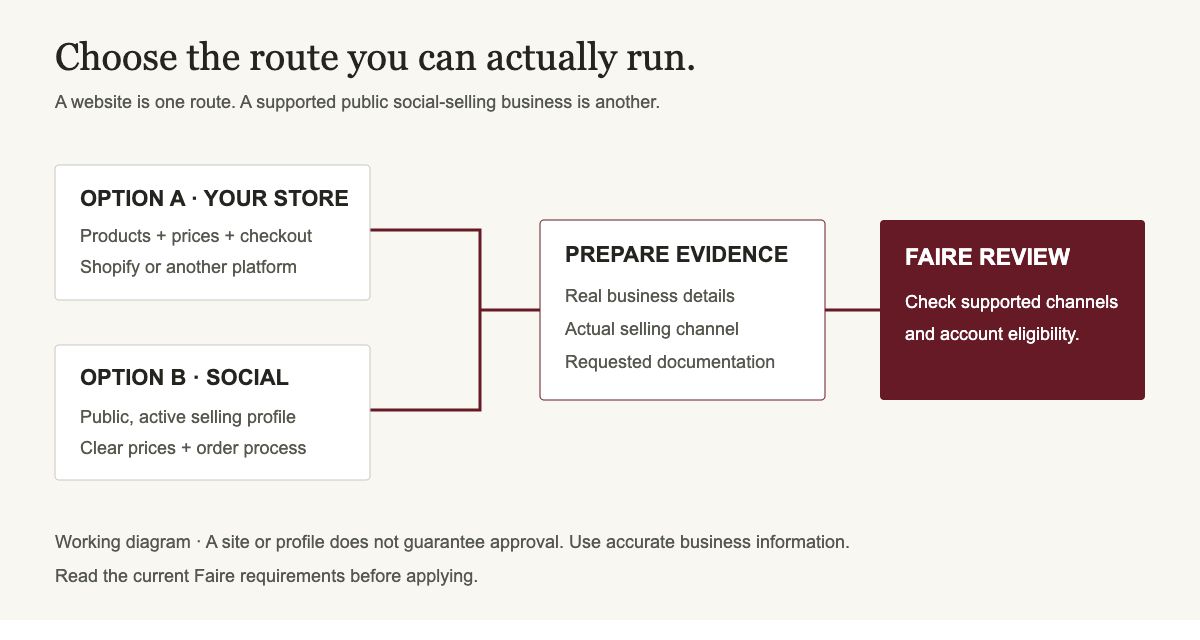
A considered first collection starts with a clear retail plan. Before applying to a wholesale platform, know who the products serve, how customers will order and where stock will be received. This US-focused checklist helps you prepare those details alongside the information Faire may request.
You can begin with an eligible social selling operation, an independent store or another supported business model. Shopify is an optional selling tool. Purchasing a subscription does not replace business verification, and a fixed number of posts is not an approval formula.
Check that your channel fits before spending on setup
Faire supports qualifying physical shops, online stores and consistent pop-ups, as well as certain business-use purchases. Public social selling is supported on specified channels, including Instagram and Facebook; private groups and several third-party marketplaces are excluded. Some brands restrict online-only buying. Review the current business-type and channel requirements.
Write down every channel you actually use and where you intend to sell the products you purchase. If your only current route is an unsupported marketplace, solve that business-model question before placing an order. A different profile description does not change where goods are sold.
For online stores still being developed, Faire may review detailed development screenshots, but orders can be canceled if the shop is not live. Confirm your circumstances with Faire. Keep the discussion focused on the real stage of the business.
Make your public business understandable
Look at the store or profile from a stranger’s perspective. Can they identify the type of products, see prices, understand how to order and find a working contact route? For a public social operation, real posts and genuine activity should describe a functioning business rather than an empty profile created solely for an application.
Use consistent names across the website, business email and application. Where your legal name and trading name differ, keep documentation that explains the relationship. Record the correct version instead of trying to make unrelated names look identical.
If you need help with the public-facing pages, choose the Instagram buying-path guide or the optional Shopify setup guide. Both focus on serving customers. Photographs, polished graphics and helpful policies can communicate your operation, but none guarantees supplier approval.
Prepare evidence of the business you actually run
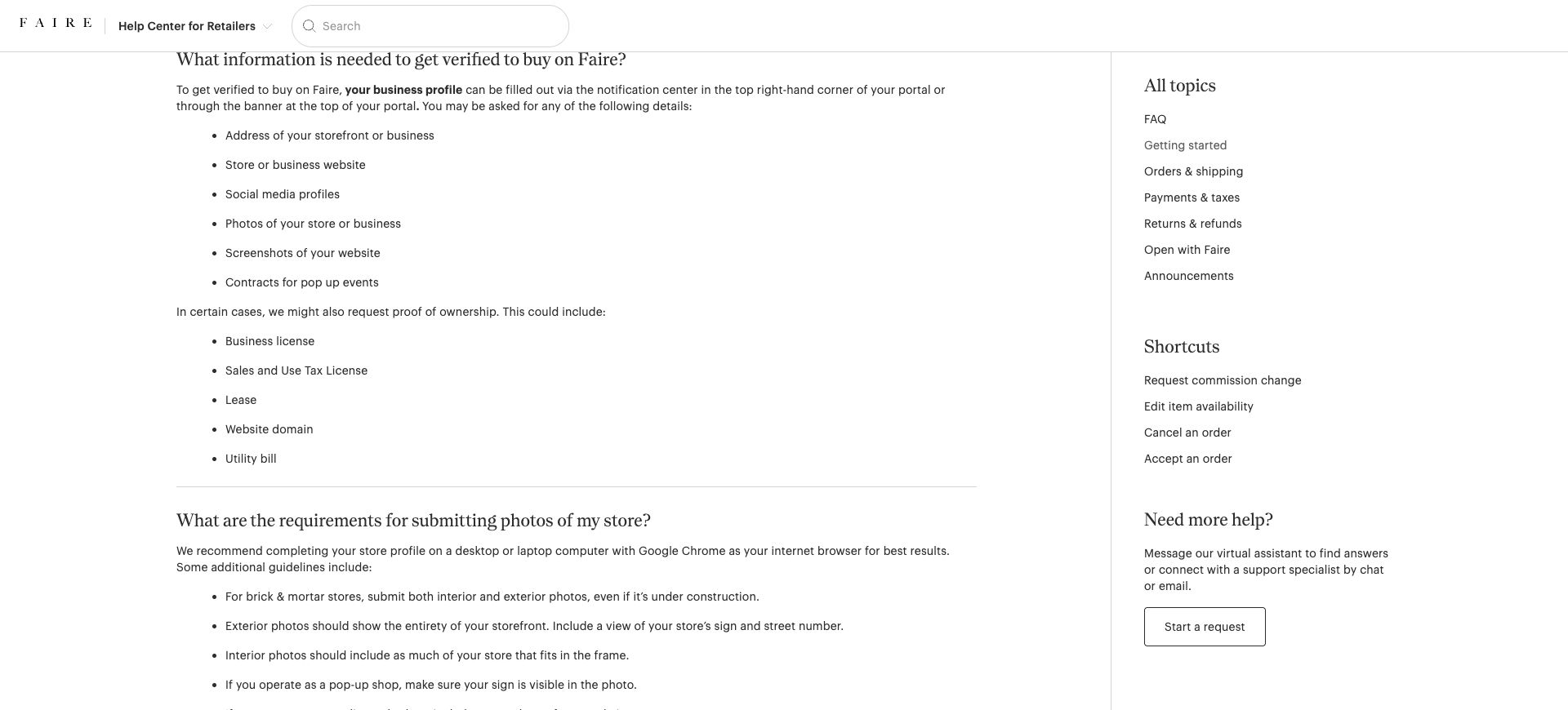
Faire may request a business address, website, social profiles, store photos, development screenshots or pop-up documentation. It can also request ownership evidence. Submit the items requested through the official process, using accurate current information. Read Faire’s verification guidance.
Create a private folder with clear filenames and a short index. Note what each document establishes and whether it is current. Keep drafts separate from completed documents, and never put identity or registration documents in a public shared starter-kit folder.
For a pop-up, organize the event agreement and details of where and when you sell. For a website, record the public address and the pages showing your products and order process. For social selling, supply the correct public business profile rather than a private personal account.
Check local business and tax information directly
Use the registration prompts and your own state or local authority’s guidance to identify the relevant business and resale documentation. Requirements vary by location and business structure. A downloadable template cannot create a valid registration or replace a required certificate.
List the questions you cannot yet answer: which name belongs on the application, which document demonstrates resale status, or which address is appropriate for receiving stock. Bring those specific questions to Faire support or a qualified local adviser. Do not enter invented values to move past a required field.
Separate account readiness from order readiness
You can have a well-documented business and still need to plan the purchase. Describe the customer, the sales channel, the product range and the amount you can commit. Identify where stock will be received, checked and stored. Decide who handles a missing item or damaged package.
Faire is wholesale procurement rather than a dropshipping service. It does not support personal-use shopping or redistribution, and products must be used or resold in supported locations. Review how buying on Faire works. For a home business, include the work of receiving goods and fulfilling your own customer orders in the weekly plan.
Choose a purchasing ceiling that leaves money for packaging, selling costs and a reserve. Write down the information you still need from a supplier: exact material, dimensions, variant, case quantity, order minimum, dispatch estimate or photo permission. The clearer those questions, the more useful the supplier conversation.
Prepare a collection brief you can use with suppliers
For a jewelry direction, separate the style decision from the specification questions. Your brief might describe an everyday collection, followed by the exact finishes, size range, quantity ceiling and material information you need. Ask about image use and presentation alongside the goods themselves. If you choose another category, keep the same structure and adapt the detail questions.
Your wholesale-readiness worksheet
| Check | My answer or evidence | Next action |
|---|---|---|
| Country and business location | ________________ | ________________ |
| Actual selling channel and public link | ________________ | ________________ |
| Business and contact names | ________________ | ________________ |
| Requested registration or resale document | ________________ | ________________ |
| Product customer and buying purpose | ________________ | ________________ |
| Stock receiving and storage plan | ________________ | ________________ |
| Purchase ceiling and reserve | ________________ | ________________ |
Mark each row Ready, Needs work or Not applicable, with a reason. Then choose the smallest unresolved action you can complete next. That might be publishing accurate product prices, finding an event contract or confirming your shipping address. Complete that task before opening more supplier accounts.
Choose the next step that fits
Once your readiness checklist is complete, plan your first collection and quantities. If your products and budget are already decided, continue to the Faire signup and first-order checks. Still choosing a direction? The starting-point quiz can help you pick a next action.
Our own wholesale collection is jewelry. It can be a sourcing option when jewelry fits your customer and plan; choosing another category is a valid outcome. Build the business around a suitable product rather than around access to an offer.
Keep the information consistent.
Practice checklist only. Answers stay on this page and are not submitted or saved.
FINISH THIS STEP, THEN CONTINUE
Resolve the gaps, then plan the order
Complete the checklist and resolve missing business information. If you already know your products, variants and budget, you can skip the example and use the signup guide.
Next: plan a small first collection →
Already have a buying plan? Continue to signup and checkout checks →
Put the checklist to work.
Get a personal starting plan, the printable workbook, and a starter kit with setup checklists, editable worksheets and social-post templates.
Find my first step + get the kit →See your summary first. Request the complete plan and files by email. No purchase required.